
Most parents have watched their toddler walk straight past a toy box full of things that light up, sing and spin, only to open and close the kitchen cupboard for the twentieth time, unzip the nearest bag, or spend ten absorbed minutes pushing a lid on and off a container. At first, it is puzzling why the toys designed to hold their attention end up losing out to everyday objects.
There is a reason, and it sits at the heart of Montessori toys. Toddlers are wired to do real things with their hands, and the toys that keep them absorbed longest are the ones that let them. Below, we look at what Montessori toys actually are, the features that set them apart from regular toys, and why they work so well for toddler development. You will also find a simple guide to choosing the right ones, from newborns up to 3-year-olds.
What Are Montessori Toys?
Montessori toys are simple, hands-on toys designed to help children build real skills through self-directed play. Each one usually focuses on a single skill, uses tactile materials, and lets the child work out the answer on their own rather than being entertained by the toy. The idea is that the child does the work, and the toy simply makes that work possible.
The approach comes from Dr. Maria Montessori, an Italian physician and educator who opened her first classroom in Rome in 1907. Watching children closely, she noticed they concentrated deeply when given purposeful, real-world tasks matched to their stage of development, and she designed learning materials around that observation. Today, Montessori toys bring the same thinking out of the classroom and into the home.
It is worth knowing that “Montessori” refers to an educational philosophy rather than a protected label or certification, so any toy can be marketed with the word attached. That makes the features behind the name far more useful to understand than the name itself.
Key Features of Montessori Toys
Montessori toys come in many shapes, but the ones that genuinely follow the approach share a handful of design principles. Each one exists for a reason, and together they explain why these toys hold a toddler's attention so well.
One Skill at a Time
Each Montessori toy tends to isolate a single skill or concept, whether that is posting a shape through a matching hole, turning a key, or fastening a buckle. Keeping the focus narrow means a toddler is never overwhelmed by too many possibilities at once. They can concentrate fully on one challenge, repeat it until it clicks, and feel the satisfaction of mastering it before moving on.
Grounded in Real Life
Toddlers are fascinated by the everyday world adults move through, the zips, laces, latches and lids they watch being used all day. Montessori toys lean into that curiosity with practical life skills rather than fantasy. Learning to zip a pocket or fasten a buckle feels meaningful to a child because it connects directly to things they see and want to do themselves.
Natural, Tactile Materials
Montessori toys favor materials that feel interesting in small hands, such as wood, felt, fabric and metal, each with its own weight, texture and temperature. That variety gives toddlers rich sensory feedback every time they play. Quality matters more than any single material here, so look for toys that are sturdy, non-toxic and pleasant to touch.
Self-Correcting by Design
Many Montessori toys have what Maria Montessori called a "control of error," meaning the toy itself shows the child whether they got it right. A shape only fits the correct hole, and a buckle either clicks shut or it doesn't. Children learn to spot and fix their own mistakes without an adult stepping in, which builds problem-solving and quiet confidence at the same time.
Child-Led, Hands-On Play
Rather than entertaining the child, a Montessori toy stays passive so the child can be active. There are no buttons that trigger a song and no lights doing the interesting part. The child decides what to try, how long to stay with it and when to move on, which is exactly the kind of self-directed play that builds concentration and independence.

Montessori Toys vs Regular Toys
The main difference between Montessori toys and regular toys is that Montessori toys rely on the child to make something happen, while many regular toys do the work for them through lights, sounds and automatic movement. That single distinction shapes how long a toddler stays focused and what they take away from playing. Here is how the two typically compare:
| Montessori toys | Many regular toys | |
|---|---|---|
| Who does the work | The child | The toy, through lights, sounds or motion |
| Focus | One skill or concept at a time | Several functions at once |
| Sound and lights | Rarely, if at all | Often central to the toy |
| Role of the child | Explores, solves and repeats | Presses a button and watches |
| Attention span | Encourages longer, deeper focus | Novelty tends to fade quickly |
| Longevity | Stays challenging as new skills develop | Often outgrown or ignored within weeks |
None of this makes regular toys bad, and plenty of children happily have both. Where Montessori toys stand out is in the quieter, longer stretches of focused play they encourage, and there is good science behind why that happens.
Why Do Montessori Toys Work?
Montessori toys work because they line up with how a toddler's brain is already developing. Maria Montessori described the early years as a series of "sensitive periods," windows when children are especially driven to master particular skills, such as fine movement, order and language. Toys matched to those windows tap into a motivation that already exists, which is why a toddler will happily repeat the same task again and again.
Each time a child works a zip or fits a shape, they strengthen the connection between hand and brain, refining the small muscle control known as fine motor skills. These skills matter well beyond play, since research has linked stronger fine motor skills in early childhood to later school readiness and achievement in reading and math.
Attention grows through this kind of play as well. Because the toy does nothing on its own, the child has to stay engaged to make anything happen, and that sustained focus strengthens with practice. Fewer toys deepen it further, as a widely cited study from the University of Toledo found that toddlers given four toys played with each one for longer and in more varied ways than toddlers given sixteen, reflecting the Montessori principle.
Self-correcting toys build independence too, since working out a problem without help gives toddlers a genuine sense of competence. That confidence carries into the everyday tasks they will soon want to do themselves, from putting on shoes to zipping up a coat.
Benefits of Montessori Toys for Toddlers and Parents
The benefits of Montessori toys reach well beyond development, showing up just as clearly in the everyday rhythm of family life. These are the changes parents tend to notice most, and often what turns them into a household favorite:
- Longer stretches of independent play – A good Montessori toy holds a toddler’s attention far longer than one that runs out of surprises, since the challenge comes from the child, and that gives you time to cook dinner or finish a coffee while it is still hot.
- A genuine alternative to screens – For flights, car rides, restaurants and the restless hour before dinner, a hands-on toy offers the calm a screen provides, without the overstimulation that tends to follow.
- Fewer toys, better play – Montessori toys work best in small numbers, so a few well-chosen pieces can replace an overflowing toy box and the clutter that comes with it.
- Toys that last across stages – The best Montessori toys grow with a child, staying challenging as new skills develop rather than being outgrown in a few weeks.
- Calmer play overall – Without flashing lights and sound effects, play tends to feel quieter and more focused, which many parents find makes the whole household feel more settled.
Put together, these are the clear reasons so many parents choose Montessori toys, which support development quietly in the background while making the hardest parts of the toddler years a little easier to manage.

The Best Montessori Toys by Age (0 to 3 Years)
Children change remarkably fast in the first three years, and the best Montessori toys keep pace by matching the skills a child is working on right now. A toy that fascinates a six-month-old will rarely hold a two-year-old for long, so it helps to know what tends to suit each stage.
0 to 12 Months: Grasping, Mouthing and Discovering
In the first year, babies explore the world through their senses, especially their hands and mouths. The right Montessori toys at this stage are simple and safe to grip and chew, like teethers, soft balls, rattles and grasping toys with interesting textures. Toward the end of the first year, object permanence boxes help babies discover that things still exist when they disappear from view, while simple open-and-close toys introduce early cause and effect.
12 to 24 Months: Posting, Stacking and Sorting
Once toddlers are on the move, they want to put things in, take things out and fit pieces together. Shape sorters, stacking rings, posting boxes and simple puzzles all match this stage, as do multi-activity cubes that combine several of these skills in one. Matching toys like geometric eggs, where each shape only fits its own shell, are a lovely example of self-correcting play at this age.
2 to 3 Years: Practical Life and Fine Motor Challenges
Between two and three, toddlers want to do it themselves, and Montessori toys can support that drive. Busy boards with zips, buckles and laces, threading toys, and sorting sets that involve grouping by color or type all build the fine motor control and independence they are reaching for. This is also the stage where practical life skills start to carry over into dressing, tidying and helping around the house.
How to Choose Between Montessori Toys
With so many toys now carrying the Montessori name, a few simple checks help separate the genuinely useful ones from the rest:
- Choose a toy that matches the skill your child is working on now, based on what they repeat and reach for.
- Look for non-toxic, certified materials and sturdy construction, with no small parts unsuitable for your child’s age.
- Pick durability over novelty, since a well-made toy that survives being thrown and chewed will be used for years.
- Keep a handful of toys out at a time and rotate them every week or two to keep each one feeling fresh.
- Avoid anything labeled Montessori that relies on lights, sounds or automatic movement, since the child ends up watching rather than doing.
Run any toy through these checks and you will quickly see whether it earns its place. The ones that pass tend to be simple, sturdy and built around real hands-on challenges, which is exactly what the toys below are designed to be.
Montessori Toys from Toddla
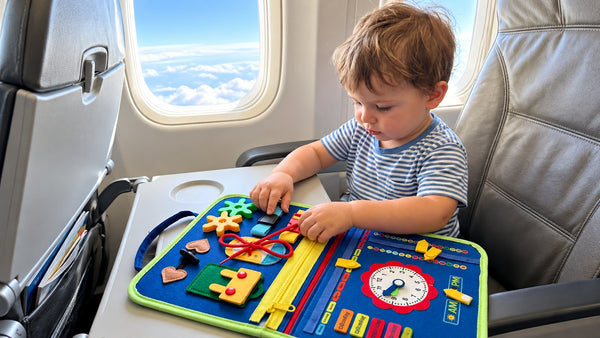
Holding a toddler’s attention, building real skills and making the hard moments easier without a screen is a lot to ask of one toy, but it is exactly what the Toddla Montessori Busy Board was designed to do. It is also why the board has become a favorite at home and on the go.
The Busy Board brings more than 30 hands-on activities together in one portable board, from zips, buckles and laces to shapes and a learning clock, all built around the practical life skills toddlers are so eager to master. There are no batteries and no noise, just real challenges for busy hands, and the Plus version adds an alphabet, numbers and animal puzzles for children ready for early learning.
Made from certified non-toxic felt with reinforced stitching, the board folds down small enough for a diaper bag, so it is just as useful on a flight as it is on the living room floor. The detachable pages let you lighten it for the car seat or share it between siblings, and as with any toy with small fastenings, younger toddlers should play with supervision.
For other stages, the 7-in-1 Montessori Cube brings several activities together for toddlers learning to sort, post and explore, while the Montessori Geometric Eggs offer simple, self-correcting shape matching. Every toy in the Toddla Montessori Toys Collection is CE-certified, non-toxic and backed by a 30-day money-back guarantee, so you can see how your toddler takes to it with no risk.

Final Thoughts
Montessori toys are less about a particular look or label and more about a simple idea. Give toddlers real things to do with their hands, and they will happily concentrate, repeat and learn. One skill at a time, real-world challenges, self-correcting design and child-led play are what make them work, and they show up for parents as calmer, longer stretches of independent play.
Start with your child, notice what they are drawn to right now, and choose a few well-made toys that match it. A small, thoughtful selection will do far more than a full toy box, and for a single toy that covers a lot of ground, the Toddla Montessori Busy Board is an easy place to begin.